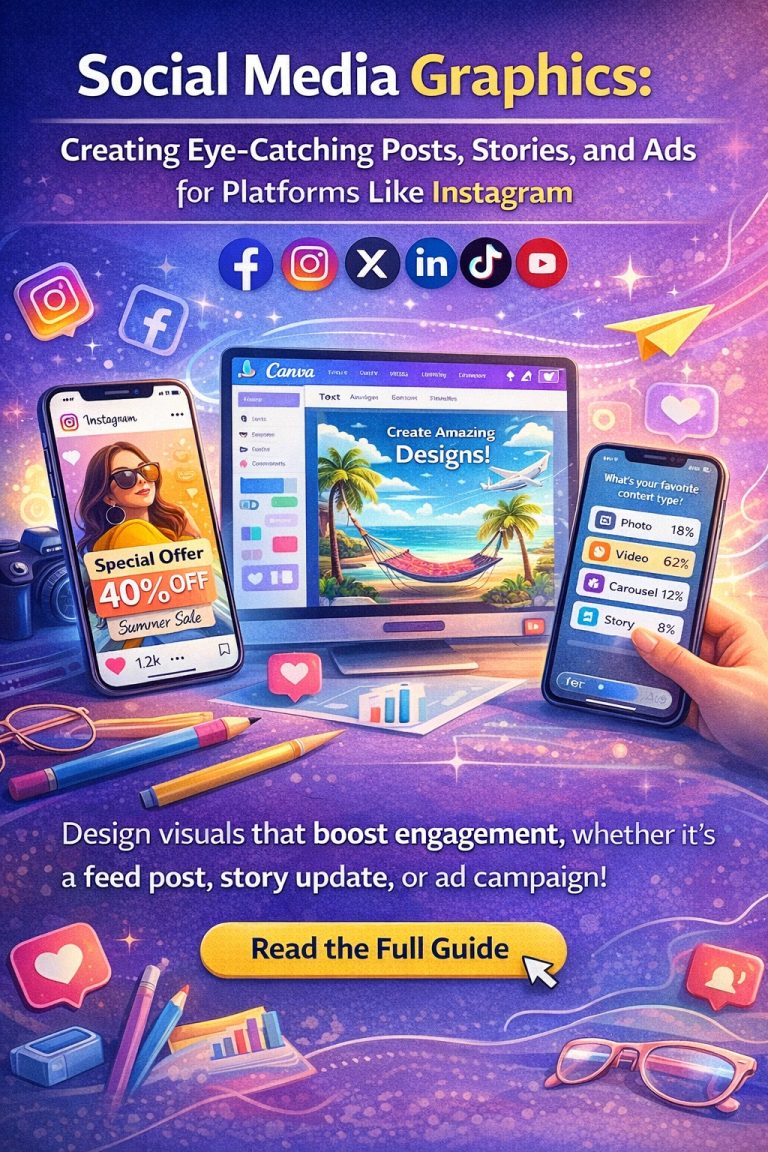
In today’s fast-paced digital world, attention is the most valuable currency. On platforms like Instagram, users scroll in seconds—meaning your graphics must capture interest instantly. Whether you’re a designer, content creator, or brand owner, strong social media visuals can make the difference between being noticed or ignored.
This blog explores how to create eye-catching social media graphics for posts, stories, and ads that stand out and drive engagement.
Before opening any design tool, understand why you’re creating the graphic. Every visual should have a clear goal:
Promote a product or service
Increase brand awareness
Drive traffic or sales
Educate or inspire an audience
When your purpose is clear, design decisions become easier and more effective.
Instagram posts need to make an impact within the first few seconds.
Make the most important element stand out—whether it’s text, an image, or a product. Use size, contrast, and spacing to guide the viewer’s eye.
Avoid clutter. Use short, clear headlines or phrases that spark curiosity. Let your caption do the explaining.
Consistent colors, fonts, and design styles help build recognition. When people see your post, they should instantly know it’s yours.
Stories are immersive and vertical, making them perfect for fast, interactive content.
Always design in a 9:16 ratio. Keep text and important elements away from the top and bottom where UI elements appear.
Use animated text, stickers, polls, and swipe prompts. Movement naturally grabs attention and keeps viewers watching.
A sequence of 3–5 story slides works better than a single frame. Build curiosity, deliver value, then end with a call to action.
Ads must be visually appealing and strategic.
Avoid trying to say everything at once. One message, one visual focus, one action.
Most users view ads on their phones. Use large text, high contrast, and clear visuals that read well on small screens.
Whether it’s “Shop Now,” “Learn More,” or “Sign Up,” your CTA should be obvious and compelling.
Popular design tools include:
Canva (great for beginners)
Adobe Photoshop & Illustrator
Figma
Choose tools that match your skill level and workflow.
Track engagement, saves, clicks, and conversions. Learn what works and refine your designs accordingly.
Social media design trends evolve quickly. Keep an eye on typography styles, color palettes, and content formats—but don’t sacrifice your brand identity.
Creating eye-catching social media graphics isn’t just about looking good—it’s about communicating clearly, connecting emotionally, and inspiring action. With intentional design, consistency, and creativity, your posts, stories, and ads can stand out in even the most crowded feeds.
Design with purpose, and let your visuals speak louder than words.

Cinematic videography has never been more in demand. Brands, artists, businesses, and creators all want visuals that feel emotional, immersive, and story-driven. But turning cinematic videography into a freelance career takes more than a good camera and creative eye. You need a strong portfolio, smart pricing, and real connections.
This guide breaks down the three pillars of freelancing success for cinematic videographers.
Your portfolio is your most powerful marketing tool. Before clients ask about your rates, they want to see what you can do.
Five strong cinematic projects are better than twenty average ones. Choose work that shows:
Strong composition and lighting
Intentional camera movement
Color grading consistency
Clear storytelling or mood
If you’re just starting out, create spec work—short films, travel edits, or passion projects. Clients care more about results than whether it was paid work.
Don’t try to appeal to everyone. Whether your style is moody, commercial, documentary, or high-energy, make it obvious. Clients hire videographers whose vision matches their brand.
A 60–90 second cinematic showreel is essential. Lead with your strongest shots, keep pacing tight, and match visuals to music. This reel should instantly communicate your level and style.
Pricing is one of the hardest parts of freelancing—but underpricing hurts both you and the industry.
You’re not just charging for shooting time. Your rate should reflect:
Pre-production (planning, calls, location scouting)
Production (gear, shooting hours)
Post-production (editing, color grading, sound design)
Experience and creative direction
Many beginners price only by the hour, but project-based pricing is often better and clearer for clients.
When starting out, it’s okay to charge lower—but not unsustainably low. As your skills, demand, and confidence grow, raise your prices gradually.
A good sign it’s time to raise rates:
You’re fully booked
Clients don’t question your price
You’re turning down work
Explain what’s included in your price and deliverables. Confidence in your pricing builds trust and positions you as a professional, not a hobbyist.
Freelancing thrives on relationships. Talent gets attention—but connections get consistent work.
Platforms like Instagram, TikTok, and YouTube are powerful for cinematic videographers. Post:
Short cinematic clips
Behind-the-scenes content
Before-and-after color grades
Personal projects
Consistency matters more than going viral.
Work with photographers, musicians, models, designers, and content creators. These collaborations often lead to referrals and long-term partnerships.
Don’t underestimate real-world networking:
Film meetups
Creative events
Local businesses
Community projects
A simple conversation can turn into your next client.
Clients remember how you made them feel. Be professional, reliable, and communicative. Happy clients are your best marketers—they bring repeat work and referrals.
Freelancing as a cinematic videographer is a long game. Focus on refining your craft, presenting your work clearly, pricing yourself fairly, and building genuine connections. Growth may be slow at first, but consistency compounds.
Your camera captures stories—but your mindset builds your career.
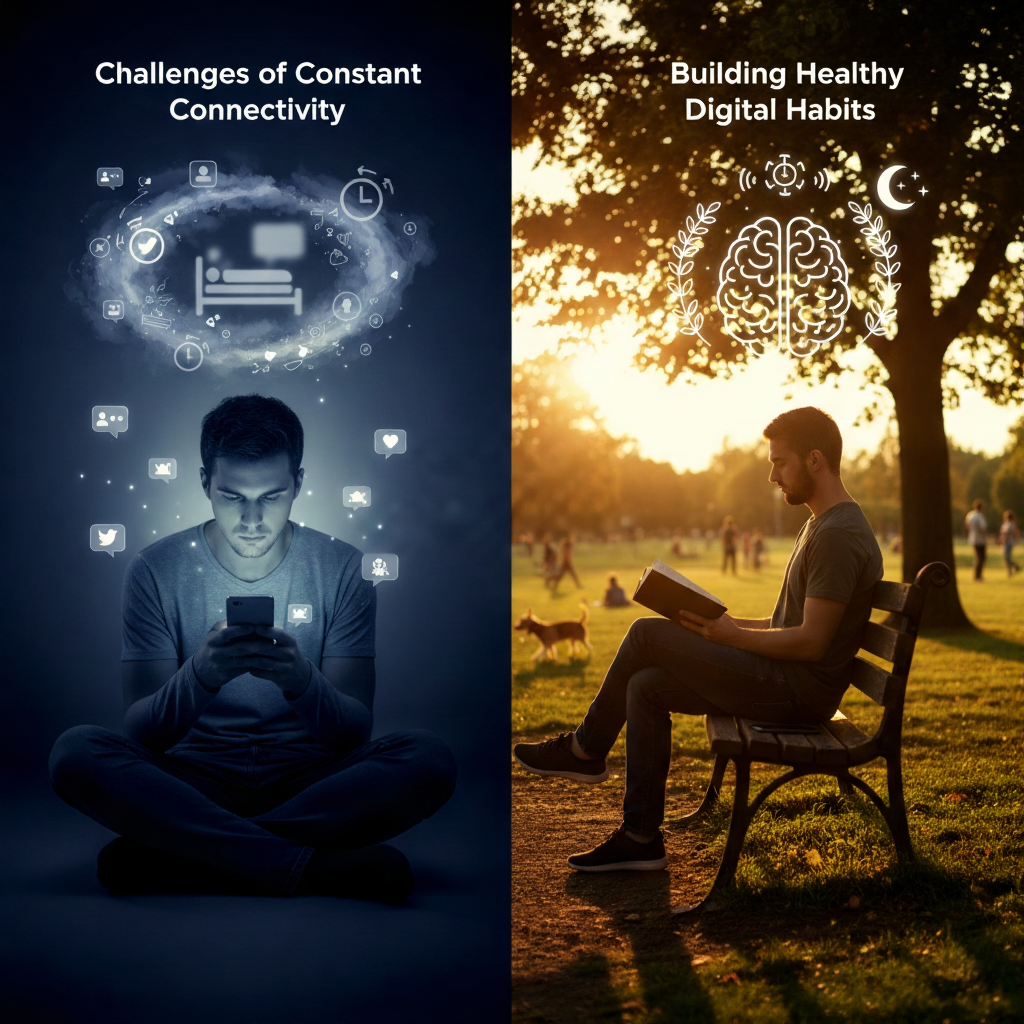
Technology is deeply woven into our daily lives. From smartphones and social media to online learning and remote work, digital tools help us stay connected and productive. But constant screen time, notifications, and information overload can also take a toll on our mental, emotional, and physical health.
Digital wellbeing is about creating a healthier, more balanced relationship with technology—one that supports your life instead of controlling it.
Digital wellbeing refers to the impact of digital technology on our overall health and quality of life. It focuses on how we use technology, not just how much we use it.
A strong sense of digital wellbeing helps you:
Stay focused and productive
Reduce stress and screen fatigue
Improve sleep and mental clarity
Maintain healthy relationships offline
While technology offers convenience, overuse can create challenges such as:
Reduced attention span
Social comparison and anxiety
Poor sleep due to late-night screen use
Burnout from constant notifications
Being online all the time can blur the boundaries between work, school, and personal life.
Improving digital wellbeing doesn’t mean giving up technology—it means using it more intentionally.
Use app timers or daily limits to prevent excessive scrolling. Even small reductions can make a big difference.
Designate certain times of day—like meals or before bedtime—as screen-free. This helps your mind rest and recharge.
Not every alert deserves your attention. Reduce distractions by allowing notifications only from essential apps.
Social media and online spaces can influence self-esteem and mood. It’s important to:
Follow accounts that inspire or educate you
Unfollow or mute content that triggers negativity
Remember that online content often shows highlights, not reality
Being mindful of what you consume digitally is just as important as how long you consume it.
Technology itself can also be part of the solution. Many apps and devices now offer features such as:
Screen time tracking
Focus modes
Sleep reminders
Wellness and mindfulness tools
When used correctly, digital tools can help you create healthier habits.
Digital wellbeing is not about perfection—it’s about awareness and balance. By setting boundaries, being intentional with screen time, and prioritizing real-life connections, you can enjoy the benefits of technology without feeling overwhelmed by it.
A healthier digital life leads to a healthier real life.
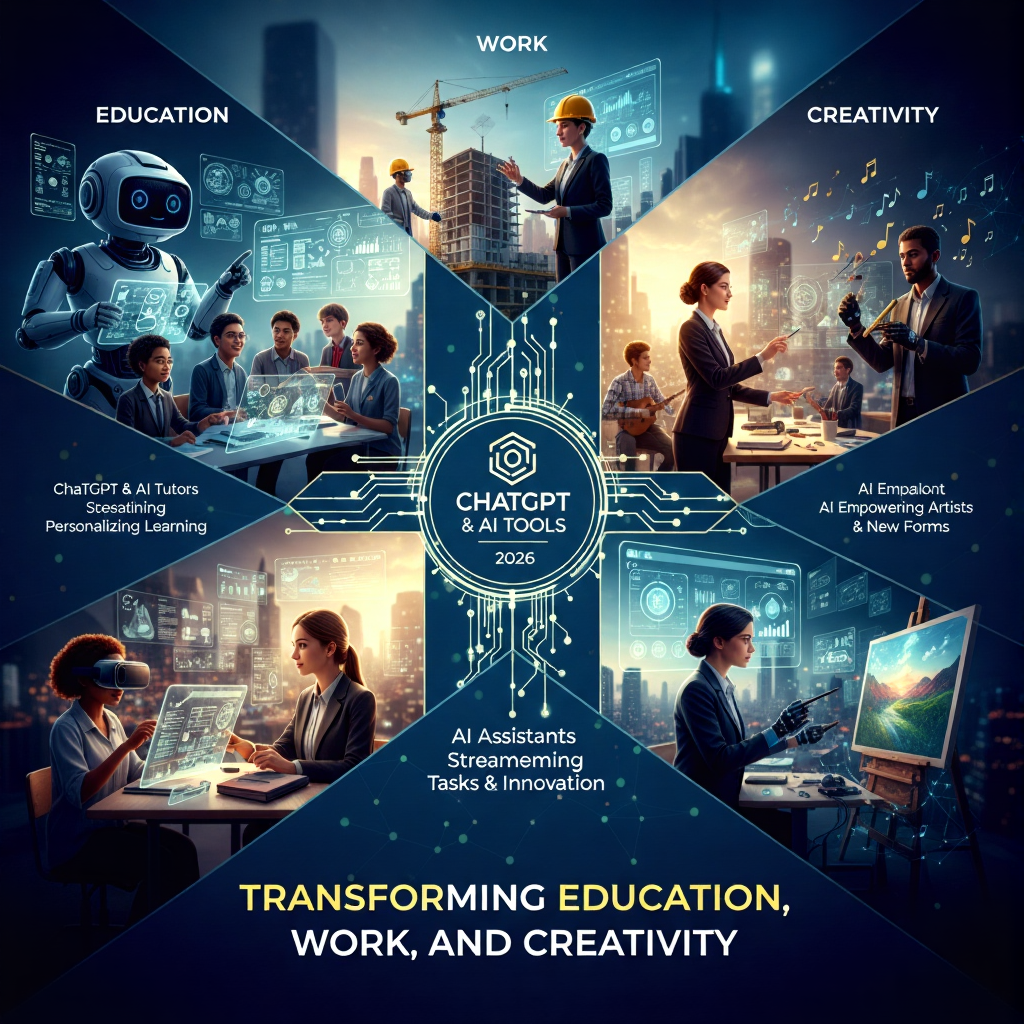
Artificial intelligence (AI) is no longer a futuristic concept—it’s reshaping how we learn, work, and create right now. Tools like ChatGPT and other AI systems are becoming integral parts of everyday life in classrooms, offices, and creative industries. In 2026, this transformation is accelerating rapidly, bringing both opportunities and challenges.
Below we explore the key ways AI is changing education, work, and creativity—supported by recent data and expert analysis.
AI tools are fundamentally transforming how students learn and how educators teach. These technologies are helping tailor education to individual needs in ways that were previously impossible.
Personalized Learning: AI‑based platforms can adapt lessons to each student’s pace and level, offering real‑time feedback and support where traditional methods fall short. This is especially valuable in large classrooms where individual attention is scarce. (www.ndtv.com)
Teacher Support: Educators are using tools like ChatGPT to simplify lesson planning, design assessments, and reduce administrative workload, freeing up more time for meaningful interactions with students. (Phys.org)
Creative Thinking: AI can spark imagination and support creative learning by helping students generate new ideas, explore concepts visually, and collaborate on projects. For example, reports show that using generative AI in education boosts creative exploration and skill development across subjects. (Adobe Blog)
In short, AI is not replacing teachers—it’s augmenting their capabilities and creating new educational possibilities.
The workplace of 2026 is increasingly AI‑enhanced. Instead of simply automating tasks, AI tools are becoming collaborative partners that help humans do their jobs better.
According to tech trend forecasts, enterprise adoption of AI tools is expanding rapidly, with businesses integrating AI into core operations to boost performance and efficiency. (Barron’s)
Tools that once existed on the periphery, such as AI assistants for coding, data analysis, or content generation, are now mainstream components of many workflows. (Nexford University)
However, growing reliance on AI has sparked debate about job roles. Some see AI as redefining job descriptions rather than eliminating jobs entirely, creating a partnership between humans and machines where routine tasks are automated and humans focus on strategic thinking. (TradingView)
To thrive, professionals need a blend of AI literacy and uniquely human capabilities such as critical thinking, emotional intelligence, and creativity. For example, research underscores the continued importance of skills like source evaluation and strategic reasoning alongside AI fluency. (The Times of India)
AI isn’t just changing routine tasks—it’s reshaping how people create.
Generative AI tools are lowering barriers to creative production across writing, design, video, and music, allowing individuals to rapidly prototype ideas or visualize concepts. (Forbes)
In educational contexts, AI encourages students to explore creative projects that were once limited by skill or time, making creative expression more inclusive and accessible. (Adobe Blog)
For professionals in creative industries, the challenge now is to view AI as a creative partner rather than a threat—a tool that helps explore novel directions, accelerate ideation, and push boundaries of artistic expression.
Of course, this transition raises questions about authorship, originality, and ethical use of AI in creative work—but it also opens new avenues for innovation.
While the impact of AI is transformative, it’s not without concerns.
Experts warn that overreliance on AI could erode certain human skills like deep analysis and critical thinking if not balanced with conscious practice. (Business Insider)
Education and workplace training still need to catch up, as not all teachers or workers have AI fluency yet, and uneven adoption can widen skill gaps. (Complete AI Training)
Ethical considerations, such as bias, data privacy, and transparent use of AI, remain front and center as these tools become commonplace across sectors.
Meaningful integration of AI requires not just technology adoption, but literacy, ethical standards, and the preservation of human expertise.
In 2026, ChatGPT and AI tools are no longer fringe technologies—they’re essential forces shaping how we learn, work, and create. Their impact is broad and deep: from classroom collaboration and personalized learning to enhanced productivity and democratized creativity.
But the future won’t be defined by technology alone. The key to success lies in how we use AI—responsibly, ethically, and creatively—to amplify human potential rather than replace it.
Would you like me to add images, charts, or headline variations for this blog post? Just let me know!
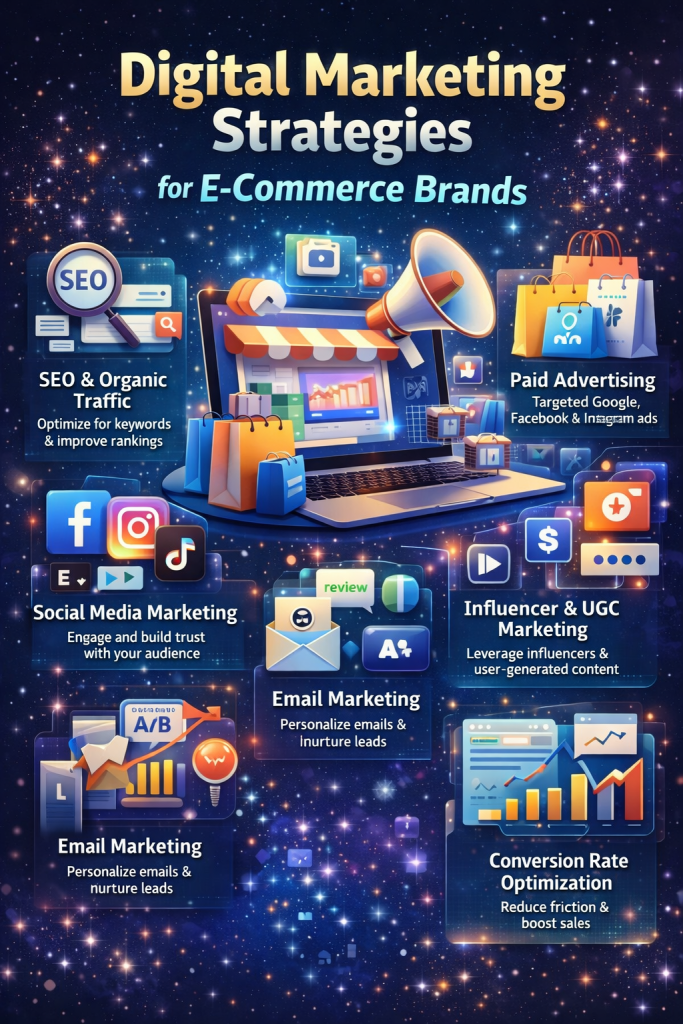
In today’s competitive online marketplace, simply having an e-commerce website is not enough. With thousands of brands competing for customer attention, digital marketing has become the backbone of e-commerce success. The right strategies help brands attract quality traffic, increase conversions, and build long-term customer loyalty.
This blog explores the most effective digital marketing strategies for e-commerce brands to grow sales and stay ahead in 2026 and beyond.
SEO is one of the most cost-effective strategies for long-term growth. Optimizing product pages, category pages, and blog content helps your store rank higher on Google and attract organic traffic.
Key SEO practices include:
Keyword-optimized product titles and descriptions
High-quality product images with alt text
Fast website loading speed and mobile optimization
Creating informative blogs related to your products
When done right, SEO drives consistent, high-intent traffic that converts better than paid ads.
Paid ads are essential for quick results and scaling sales. Platforms like Google Ads, Facebook Ads, and Instagram Ads allow e-commerce brands to target customers based on behavior, interests, and purchase intent.
Popular ad strategies:
Google Shopping Ads for product visibility
Retargeting ads for cart abandoners
Social media ads for new product launches
Performance-based campaigns focused on ROAS
Paid advertising ensures your products reach the right audience at the right time.
Social media platforms play a major role in influencing purchase decisions. Consistent posting, engaging content, and short-form videos help e-commerce brands connect emotionally with customers.
Effective social media strategies include:
Product demos and unboxing videos
Customer reviews and testimonials
Influencer collaborations
Interactive stories, polls, and reels
A strong social media presence builds trust, improves brand recall, and drives repeat purchases.
Content marketing helps e-commerce brands provide value beyond selling products. Blogs, videos, and guides educate customers and position your brand as an authority.
High-performing content ideas:
Buying guides and product comparisons
How-to tutorials and styling tips
FAQs and problem-solving blogs
Video marketing for product usage
Good content improves SEO, boosts engagement, and supports the entire sales funnel.
Email marketing remains one of the highest ROI digital marketing channels for e-commerce. It helps brands nurture leads and retain existing customers.
Effective email campaigns include:
Welcome emails for new users
Abandoned cart recovery emails
Personalized product recommendations
Festival offers and exclusive discounts
Email marketing turns one-time buyers into loyal customers.
Influencer marketing builds credibility and expands brand reach. Partnering with niche influencers helps showcase products to highly targeted audiences.
Additionally, user-generated content (UGC) like reviews, photos, and videos increases social proof and conversion rates.
Driving traffic is important, but converting visitors into buyers is critical. CRO focuses on improving the shopping experience.
Key CRO elements:
Simple checkout process
Clear call-to-action buttons
Trust badges and secure payment options
Mobile-friendly design
Small changes in UX can lead to significant revenue growth.
Using tools like Google Analytics, Meta Pixel, and heatmaps helps e-commerce brands understand customer behavior. Data-driven decisions improve ad performance, website experience, and overall ROI.
E-commerce success depends on a well-planned digital marketing strategy that combines SEO, paid ads, social media, content, email marketing, and analytics. Brands that focus on customer experience, personalization, and data-driven decisions are the ones that scale faster and sustain long-term growth.
By implementing these digital marketing strategies, e-commerce brands can increase visibility, boost conversions, and build a powerful online presence in today’s competitive digital world.
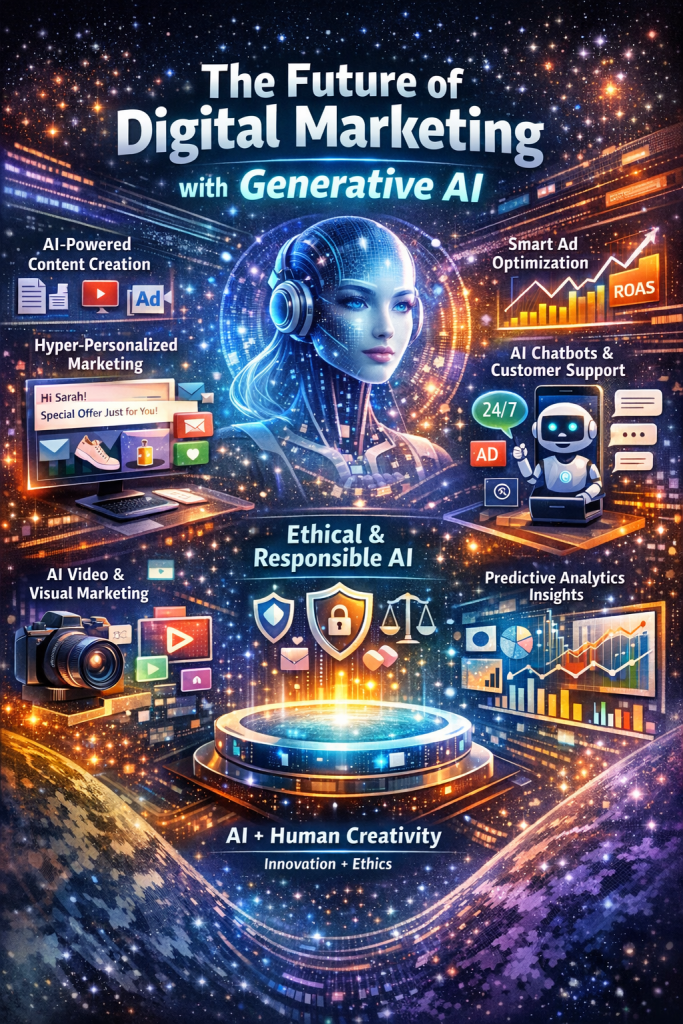
Generative AI refers to advanced AI models capable of creating content such as text, images, videos, audio, and even code. In digital marketing, it enables brands to automate creativity, personalize customer journeys, and optimize campaigns in real time.
Examples include AI-written blog content, AI-generated ad creatives, chatbots, and predictive marketing tools.
One of the biggest impacts of Generative AI is in content marketing. AI can generate blogs, social media captions, ad copies, product descriptions, and video scripts in seconds.
In the future:
Brands will produce high-quality content faster
Marketers will focus more on strategy and creativity
Content personalization will happen in real time
Human creativity combined with AI efficiency will become the new standard.
Generative AI allows marketers to deliver one-to-one personalized experiences based on user behavior, preferences, and intent.
Future applications include:
Personalized email campaigns
AI-driven product recommendations
Dynamic website content for each visitor
Customized ad messaging
This level of personalization will significantly increase engagement and conversion rates.
AI will revolutionize paid advertising by analyzing massive data sets and optimizing campaigns automatically.
Key future trends:
AI-generated ad creatives
Predictive budget allocation
Real-time A/B testing
Performance forecasting
Marketers will rely on AI to improve ROI while reducing manual effort.
Generative AI-powered chatbots will become more human-like, offering instant, personalized support across websites, WhatsApp, and social media.
Benefits include:
24/7 customer support
Faster lead qualification
Improved customer satisfaction
Reduced operational costs
Conversational AI will play a major role in lead generation and customer retention.
Video is already dominating digital marketing, and Generative AI is accelerating this trend. AI tools can create videos, animations, voiceovers, and visuals without expensive production.
Future possibilities:
AI-generated promotional videos
Automated video ads for different audiences
Personalized video messages
Faster creative testing
This will make high-quality video marketing accessible to all businesses.
Generative AI helps brands predict future customer behavior rather than reacting to past data.
With AI-powered analytics:
Marketers can predict buying intent
Improve customer journey mapping
Reduce churn rates
Make data-driven decisions faster
This shifts marketing from reactive to proactive.
As AI becomes more powerful, ethical usage will be critical. The future of digital marketing will prioritize transparency, data privacy, and responsible AI practices.
Brands must:
Use AI ethically and transparently
Protect user data
Avoid misleading or biased content
Maintain human oversight
Trust will become a key differentiator in AI-driven marketing.
The future of digital marketing with Generative AI is innovative, data-driven, and highly personalized. While AI will automate processes and scale creativity, human strategy, emotion, and ethical judgment will remain irreplaceable.
WhatsApp us
